Ventilatory and lactate threshold testing in Carlsbad.
Find the intensities that organize smarter endurance training. Both testing options use the VO2 Master during a progressive treadmill or cycling protocol. Choose ventilatory threshold testing, or add blood lactate sampling for a second physiological signal and a more detailed performance profile.
Ventilatory Threshold $150. Add lactate sampling for $75 to unlock the lactate curve and estimated FatMax and CarbMax ranges. Members save 20%.
Choose Your Threshold Testing Option
Two ways to read the same effort.
Both options assess how your body responds as exercise intensity rises. The difference is the data collected during the graded test and the level of detail included in your results.
Option 1 · $150
Ventilatory Threshold Testing
A noninvasive test that uses VO2 Master breathing and ventilation data to identify your first and second ventilatory thresholds, VT1 and VT2. Results connect those breakpoints to heart rate and, when the modality supports it, pace, speed or cycling power.
VT1 and VT2 from your ventilatory response
Individualized heart-rate and training-zone guidance
Pace, speed or power targets when captured
A repeatable baseline for programming and retesting
The same VO2 Master ventilatory test, plus small capillary blood samples collected with a portable lactate meter at planned stages. The resulting lactate curve adds a second view of your response and helps the coach compare lactate-derived breakpoints with VT1 and VT2.
Everything in Ventilatory Threshold Testing
Blood lactate values across the graded protocol
Lactate-derived thresholds using the stated method
The two methods should generally support a consistent training interpretation, but the reported breakpoints may not be numerically identical. Ventilation and blood lactate are related responses, not the same measurement. Protocol design, stage length and the method used to identify each breakpoint can also affect the result.
Combined testing provides a useful cross-check. Your coach interprets the complete pattern instead of forcing both methods to produce the same heart rate, pace or power.
Estimated FatMax and CarbMax Intensities
Fuel context, with the lactate add-on.
With the lactate add-on, we use the combined ventilatory profile, oxygen consumption, workload, heart rate and lactate curve to estimate intensity ranges associated with your highest likely fat contribution and increasing carbohydrate reliance. These estimates add context for aerobic training, longer events and fueling discussions.
Precise language
FatMax and CarbMax are estimated intensity ranges in this protocol, not direct measurements of grams of fat or carbohydrate burned. They are available with the lactate add-on and are interpreted alongside your thresholds, not in isolation.
What Happens During the Test
A staged, guided effort.
Complete the readiness screening, choose treadmill or cycling, and confirm which testing option you want.
Put on the VO2 Master mask and heart-rate sensor, then begin at a manageable workload.
Increase speed, grade or cycling power in controlled stages while the tester monitors your response.
For the lactate option, follow the designated sampling process at planned stages for a small finger or earlobe sample.
Finish at the protocol endpoint, recover and review how the identified thresholds translate into training intensity.
What Your Results Can Guide
Turn breakpoints into training intensity.
Zone 2 and aerobic-base training
Tempo, threshold and interval intensity
Heart-rate targets for running, cycling or hybrid training
Pace, speed or power targets when captured during testing
Programming decisions with an endurance coach
Progress tracking through repeat testing under similar conditions
Who Benefits
Runners preparing for road, trail or marathon events
Cyclists and triathletes building structured training zones
Hybrid and HYROX athletes balancing conditioning with strength
Athletes whose wearable zones do not match perceived effort
Coaches and clients who want repeatable data for programming
Threshold Testing Versus VO2 Max Testing
Capacity, and how to organize the work below it.
VO2 max testing describes your aerobic capacity at the upper end of exercise. Threshold testing focuses on the intensity breakpoints that help organize sustainable work below that ceiling. Many endurance athletes benefit from collecting both in one well-designed graded exercise assessment.
Aerobic Capacity
VO2 Max Testing
Measure your ceiling directly, then use threshold data to organize the training beneath it.
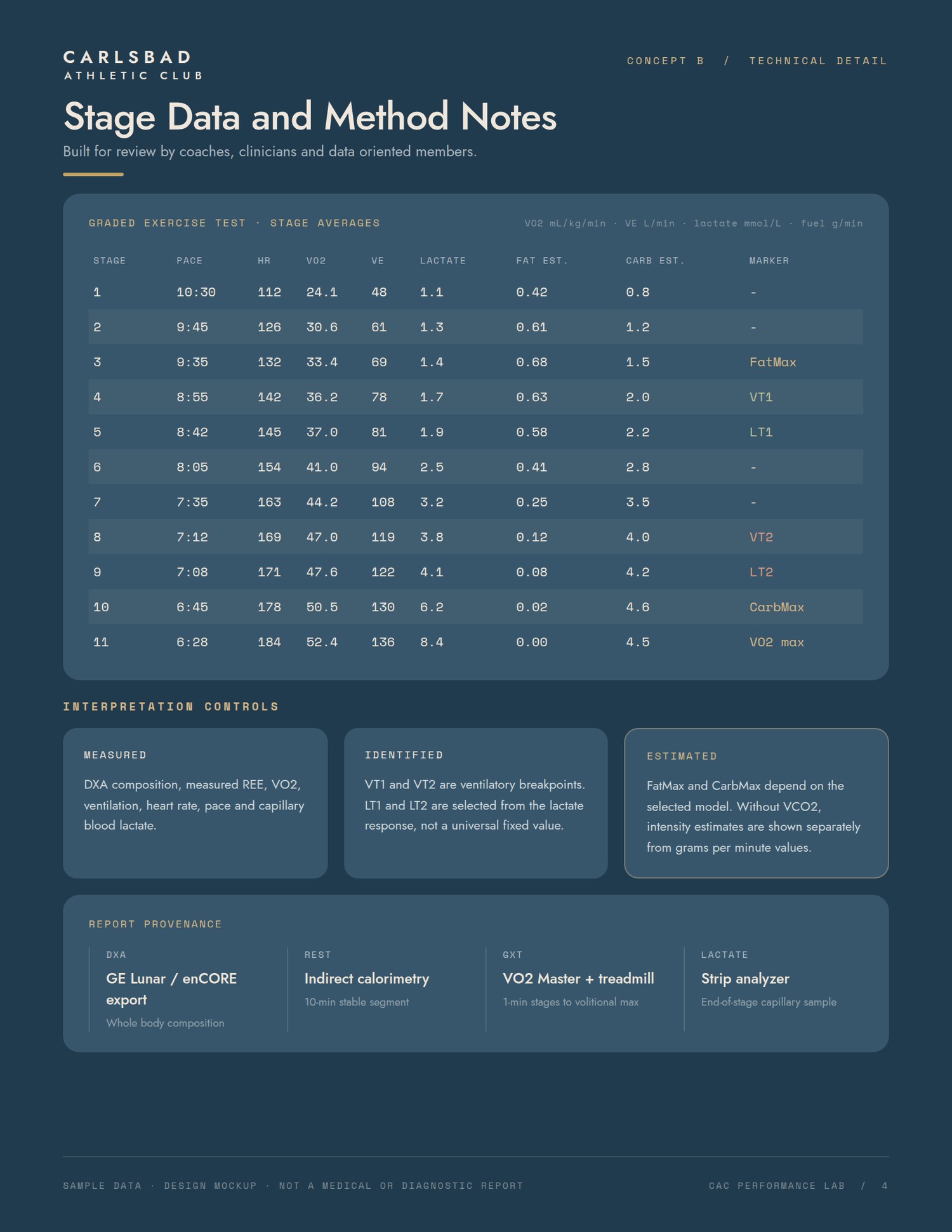
Your threshold test comes back with the full picture: stage-by-stage pace, heart rate, VO2 and ventilation, and, with the lactate add-on, blood lactate at every stage, with VT1, VT2, LT1, LT2 and your fuel landmarks clearly marked.
Sample report shown for illustration. Your report is built from your own measured data. This is a design mockup, not a medical or diagnostic report.
Frequently Asked Questions
Threshold testing, answered.
What is the difference between ventilatory and lactate threshold testing?
Ventilatory testing identifies changes in breathing and ventilation measured by the VO2 Master. The lactate option adds capillary blood samples throughout the same graded test to create a lactate curve and calculate lactate-derived breakpoints.
Will my ventilatory and lactate thresholds be the same?
They should usually support a similar training interpretation, but they may occur at slightly different heart rates, paces or power outputs because they measure related but distinct responses.
Which option should I choose?
Choose ventilatory testing for a noninvasive assessment of VT1, VT2 and training zones. Choose the lactate add-on when you want a second threshold method, a lactate curve and estimated FatMax and CarbMax intensity ranges.
Does the lactate option require a blood sample?
Yes. A small capillary sample is collected from a finger or earlobe with a single-use lancet and analyzed with a lactate test strip at planned stages of the test.
What do FatMax and CarbMax mean on this report?
They are estimated exercise-intensity ranges used to add context about likely fuel contribution as workload rises. They are not direct measurements of how many grams of fat or carbohydrate you burn.
How should I prepare?
Arrive rested and follow the pre-test instructions for training, food, caffeine, hydration, clothing and medications. Repeat the same preparation before future tests whenever possible.
Schedule Threshold Testing
Build more useful training zones.
Turn breathing, heart-rate and optional blood lactate data into training intensities you can use. Choose ventilatory threshold testing, or add lactate sampling at Carlsbad Athletic Club.
Ventilatory and lactate threshold testing at Carlsbad Athletic Club is a fitness and performance assessment intended to inform training decisions. It is not a diagnostic medical test and is not intended to diagnose, treat, cure or prevent any medical condition. The lactate option involves a small capillary blood sample using a single-use lancet. Maximal or near-maximal exercise carries inherent risk. Clients with cardiovascular symptoms, significant medical concerns or exercise restrictions should obtain appropriate medical clearance before testing.